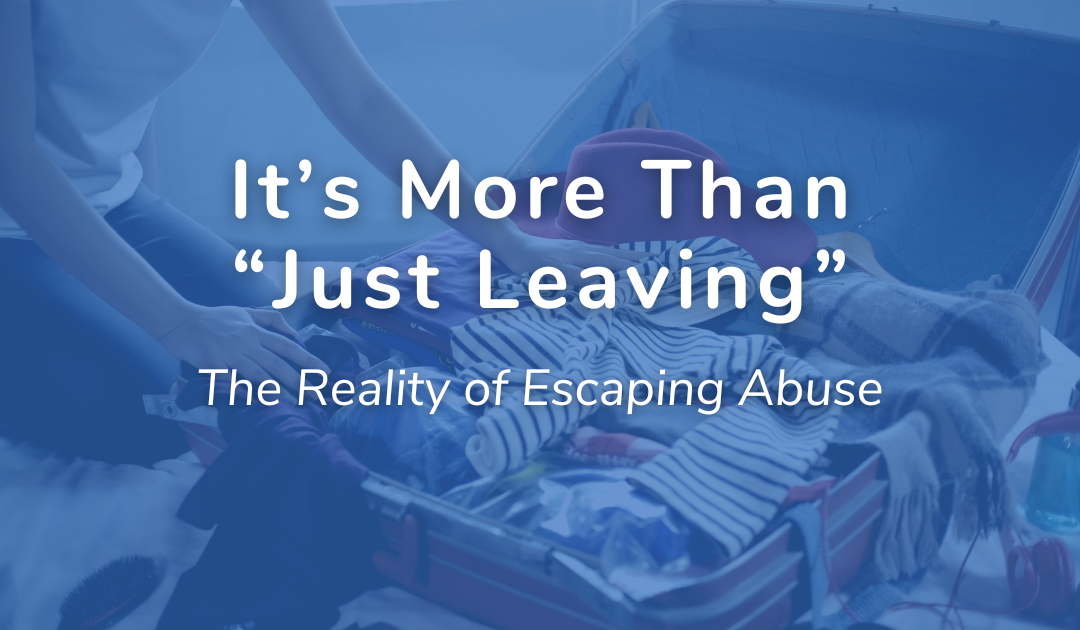
It’s More Than “Just Leaving”: The Reality of Escaping Abuse
By: India Ambrose, Advancement Manager
A Question That Misses the Reality
“Why didn’t they just leave?”
This is one of the most common questions asked after domestic violence, family violence, or tragedy.
”Just leaving” may sound simple, but often, it is not. In order to understand why someone might not “just leave”, we must look at the complex dynamics of abuse, how control builds, and how dangerous the act of leaving can actually be for survivors.
For many people experiencing abuse, leaving is not the safest moment. In fact, it is often the most dangerous time.
Domestic Violence Is About Power and Control
Violence is rarely random. It often follows a pattern of power and control. Across the United States, research consistently shows that:
- The majority of serious interpersonal violence is committed by men
- About 75% of domestic violence victims are women
- Women experience higher rates of fear, injury, and repeated abuse in relationships
The impact reaches far beyond just the individual being abused. These patterns often affect the survivor, their relationships and support systems, and communities as a whole.
Domestic violence is not just about physical harm. It is about control. Control over choices, movement, money, relationships, and safety.
When that control is threatened or perceived to be threatened, violence often increases.
Why Leaving Is the Most Dangerous Time
A common belief is that leaving ends the danger. But in reality, leaving often increases risk of harm. When a survivor leaves or attempts to leave, the person causing harm may feel a loss of control. When they feel they are losing control, violence often escalates.
Studies have shown that the risk of serious harm or homicide increases during separation or after leaving an abusive relationship. When we hear about homicides involving domestic violence in the news, they are often paired with statements such as “she had just left him”, “a Personal Protection Order had recently been granted”, or “she had just gained custody of their children.”
Asking “why didn’t they just leave” simply misses the point. Leaving is not a single choice. It is a complex process that can come with serious risks.
For many survivors, safety is not guaranteed when they stay or when they go. Safety often relies on timing, planning, and support.
Firearms and Increased Risk of Death
Access to a firearm makes domestic violence far more deadly.
Research shows:
- When an abuser has access to a firearm, the risk of homicide increases by five times for women
- Firearms are a leading factor in intimate partner homicides in the United States
- Guns are also the leading cause of death for children and teens in the country
These are important considerations when it comes to domestic violence, because children are often present in homes where abuse is happening.
Children may witness violence, be used as threats, or in the most extreme cases, be harmed directly in situations like familicide.
When a firearm is present, the time between threat and tragedy can become very short.
Children Are Also Affected
Domestic violence not only impacts the survivors, but also children in the home.
Children that have been exposed to domestic violence may experience:
- Emotional trauma from witnessing abuse
- Direct physical harm
- Regression in developmental functioning
- Loss of a parent in cases of extreme violence
- Long-term effects on mental health and safety
The impact of abuse on children can be long-lasting, even when violence is not physically directed at them.
It Is Not Simple to Leave
Leaving an abusive relationship is rarely a single decision. It is a process shaped by fear, timing, and survival.
For some survivors, the biggest barrier is fear of what will happen after they leave. For others, it can be money, housing, children, pets, or the absence of anywhere safe to go.
Abuse usually does not end when someone tries to leave. Threats, emotional pressure, and retaliation can continue or intensify during that time, making the decision even more complicated. Many survivors report years of abuse through the court systems, stalking, continued harassment, and more.
Because of the complexities of leaving abuse, it is not uncommon for it to take on average 7 times for a survivor to leave for good. It is not confusion or weakness. It is a reflection of how difficult and unsafe the process can be.
Leaving is not a single act of walking away. It is often an attempt to survive in motion.
Safety Planning Saves Lives
Because leaving can be dangerous, safety planning is a key part of support.
Safety planning is a personalized plan that helps someone stay as safe as possible while still in or leaving an abusive situation.
It can include:
- A trusted emergency contact
- A packed bag stored safely
- Copies of important documents
- A plan for where to go in an emergency
- Safety steps for work, school, or daily routines
- Providing additional emergency phones to be able to contact 911
Sometimes safety planning also includes waiting for the safest possible moment to leave.
Safety does not always look like immediate escape. Sometimes it looks like strategy.
The Role of Support Services
Organizations like Resilience: Advocates for Ending Violence exist to support survivors through every stage of this process.
This includes:
- Understanding patterns of power and control
- Helping build individualized safety plans
- Providing trauma-informed advocacy and legal support
- Supporting survivors who leave and return more than once
Survivors are not judged for their decisions. They are supported through them.
Healing and safety are not linear. Support should not be either.
Changing the Question
These stories are not isolated incidents. They reflect systems, gaps in resources, and patterns of harm that are often ignored until it is too late.
So instead of asking:
“Why didn’t they just leave?”
We need to ask:
- Why is leaving so dangerous?
- What support is missing or how can I better support survivors?
- How do we reduce risk of violence before it escalates?
When we begin to understand the realities behind asking “why didn’t they leave”, it becomes clear that leaving is not one simple choice, but a process shaped by fear, risk, and survival.
That shift allows us to respond differently, to build stronger systems of support, expand access to resources, and walk alongside survivors as they navigate what safety looks like for them. It moves us away from judgment and toward understanding, creating space for survivors to make informed decisions in their own time, with the support they need to move forward.
Sources
- Centers for Disease Control and Prevention (CDC), National Intimate Partner and Sexual Violence Survey (NISVS)
- CDC, National Center for Health Statistics (NCHS) mortality data
- CDC WONDER Database (Underlying Cause of Death data for U.S. mortality statistics)
- CDC WISQARS (Web-based Injury Statistics Query and Reporting System), including homicide and intimate partner violence data
- U.S. Department of Justice, Bureau of Justice Statistics (BJS), Homicide Trends in the United States and family violence reports
- FBI Uniform Crime Reporting (UCR) Program, Supplementary Homicide Reports
- National Institute of Justice (NIJ), U.S. Department of Justice research on intimate partner violence and lethality during separation
- Campbell, J. C. et al. (2003). Risk factors for femicide in abusive relationships. American Journal of Public Health
- World Health Organization (WHO), Violence against women prevalence estimates
- Johns Hopkins Center for Gun Violence Solutions, firearm mortality and domestic violence synthesis reports
